Blade, the French startup behind Shadow, announced plans to overhaul its subscription tiers back in October. The company is now bringing the new plans to the U.S. with a new entry tier at $11.99 per month as well as more powerful options in the coming months.
Shadow is a cloud computing service for gamers. For a monthly subscription fee, you can access a gaming PC in a data center near you. Compared to other cloud gaming services, Shadow provides a full Windows 10 instance. You can install anything you want — Steam, Photoshop or Word.
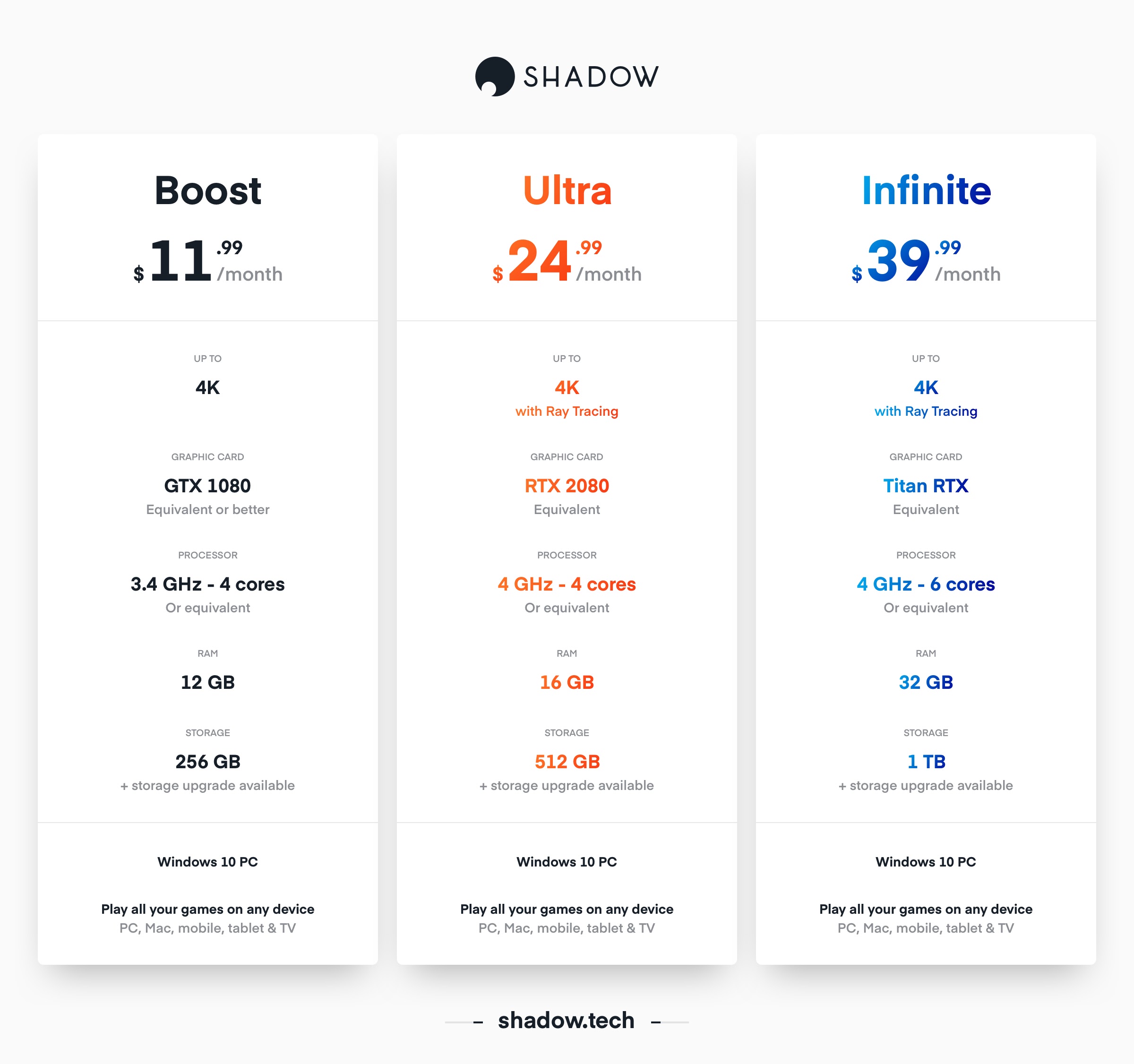
The current subscription tier, now called Shadow Boost, offers the same performance for a lower price. You get an Nvidia GTX 1080 GPU, 3.4GHz with 4 cores CPU, 12GB of RAM, 256GB of storage. It costs $11.99 per month if you sign up to a 12-month plan or $14.99 per month if you pay on a monthly basis.
Later this year, Shadow will also offer two additional plans:
- Shadow Ultra: Nvidia RTX 2080 GPU, 4GHz with 4 cores CPU, 16GB of RAM, 512GB of storage
- Shadow Infinite: Nvidia Titan RTX GPU, 4 GHz with 6 cores CPU, 32GB of RAM, 1TB of storage
These plans will cost $24.99 and $39.99 per month respectively if you subscribe to a 12-month plan — or $29.99 and $49.99 per month on a monthly basis.
Shadow Ultra and Shadow Infinite will roll out gradually starting this summer — only a limited number of users will be able to subscribe at first.
It’s worth noting that you’ll be able to add an option to get more storage with any plan. Storage plans include 256GB of SSD performance — anything above that will perform like a more traditional HDD.
The company now has four data centers in the U.S., which means that anybody in the U.S. can now access the service — not just people living on the West Coast or the East Coast.
In Europe, Shadow has had issues rolling out the new plans. While the company originally promised to deliver the new options in February, users who pre-ordered the new plans will only be able to access their new instance by the end of the summer.
Shadow offers apps for Windows, macOS, Linux, Android and Apple devices. Apple recently pulled Shadow’s apps from the App Store on iOS, iPadOS and tvOS. The company is still trying to find a solution with Apple to re-release the apps in the App Store.
In other news, the startup has signed a strategic partnership with LG Electronics. Details are thin, but LG is now a shareholder of the company. LG will also offer Shadow with some of its products.
from TechCrunch https://ift.tt/38PRdZ7
Comments
Post a Comment