
Uber Eats, micromobility services are growing faster than Uber’s core ride-hailing business

Uber’s ride-hailing business is growing more slowly than its newer bets. In Uber’s Q1 2019 earnings, the company reported gross bookings growth of 230% for its other bets, while ridesharing grew just 22% compared to the same quarter last year.

Gross bookings are the revenue earned minus things like taxes, tolls, fees, wages paid to drivers, restaurants and so forth.

Other bets, with gross bookings of $132 million for Q1 2019, includes freight and new mobility, which entails bikes and scooters. Uber did not break out specifics for new mobility, but Uber CEO Dara Khosrowshahi said on an investor conference call that gross bookings for new mobility “grew strong quarter over quarter.”

Meanwhile, Eats continues to be a revenue driver for Uber, with gross bookings growth of 108% to $3.07 billion.
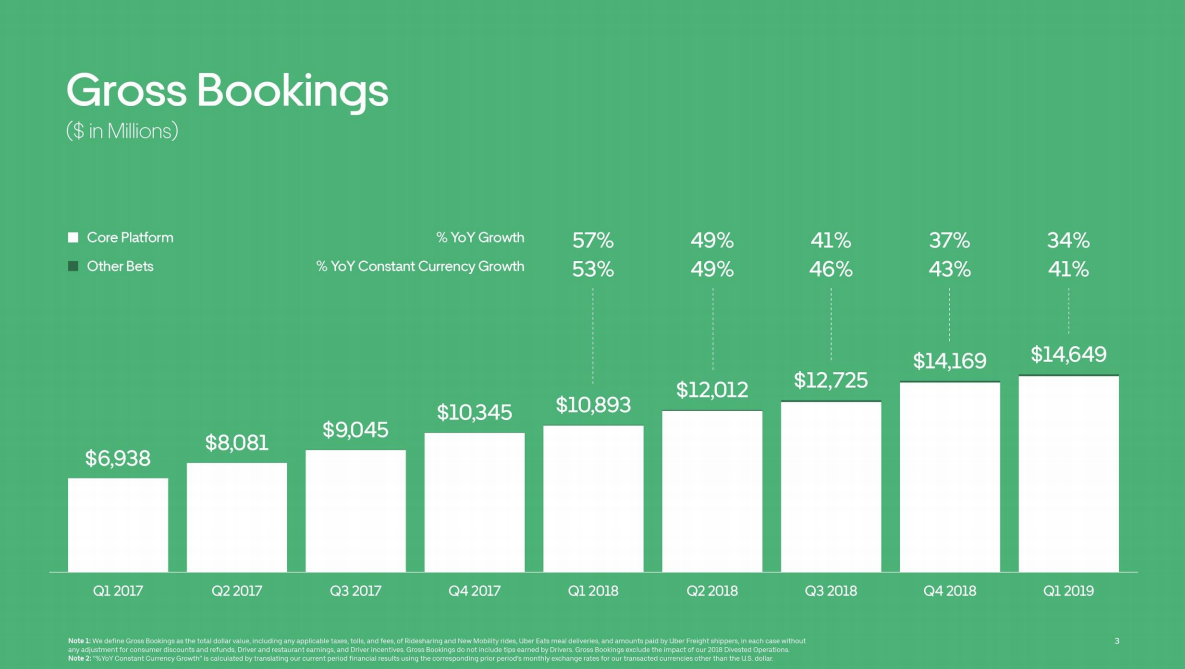
Slowing growth of Uber’s core business is to be expected. At TC Disrupt last year, Khosrowshahi said ride-hailing will make up less than 50% of Uber’s business transactions.


from TechCrunch https://tcrn.ch/2EJtddD

Comments

Popular posts from this blog

Bill Gates steps down from Microsoft’s board to focus on philanthropy

In an announcement on Friday, Microsoft revealed that company co-founder Bill Gates has decided to step down from his role on its Board of Directors in order to focus on his philanthropic efforts at the Bill & Melinda Gates Foundation. This is Gate’s biggest change to his role at Microsoft since stepping down as company chairman in February 2014. According … Continue reading from SlashGear https://ift.tt/2We90Gu

World Economic Forum launches Global AI Council to address governance gaps

The World Economic Forum is creating a series of councils that create policy recommendations for use of things like AI, blockchain, and precision medicine. Read More from VentureBeat http://bit.ly/2EKBjD4

The Flexible Permanence of Copper Tape Circuits

Somewhere between shoving components into a breadboard temporarily and committing them to a piece of protoboard or a PCB lies the copper tape method. This flexible Manhattan-style method of circuitry formed the basis for [Bunnie Huang]’s Chibitronics startup, and has since inspired many to stop etching boards and start fetching hoards of copper tape. [Hales] hit the ground running when he learned about this method , and has made many a copper tape circuit in the last year or so. He offers several nice tips on his site that speak from experience with this method, and he’ll even show you how to easily work an SMD breakout board into the mix. Generally speaking, [Hales] prefers plywood as the substrate to paper or cardboard for durability. He starts by drawing out the circuit and planning where all the tape traces will go and how wide they need to be. Then he lays out copper traces and pads, rubs the tape against the substrate to make it adhere strongly, and reinforces joints and laps w...