
Ekasbo’s Matebot may be the cutest cat robot yet created

If Shrek saw Matebot, no amount of sad-eyes could win him back to Puss in Boots’ side. Created by Shenzhen-based robotics company Ekasbo, Matebot looks like a black and white cartoon cat and responds to your touch by wiggling its ears, changing the expression in its big LED eyes and tilting its head.
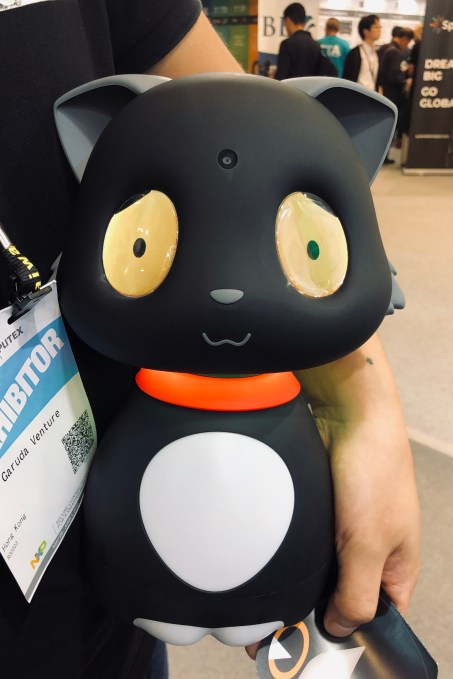
Ekasbo's Matebot in a sad mood

Built with voice recognition, infrared technology and seven moving parts, the Matebot is designed to serve as an interactive companion, including for people who can’t keep pets, creator Zhang Meng told TechCrunch at Computex in Taiwan.

The Matebot is controlled with a smartphone app and can be integrated with Android voice control systems. Its price starts at about 4,999 yen or about $45 USD.


from TechCrunch https://tcrn.ch/2WcEldT

Comments

Popular posts from this blog

Bill Gates steps down from Microsoft’s board to focus on philanthropy

In an announcement on Friday, Microsoft revealed that company co-founder Bill Gates has decided to step down from his role on its Board of Directors in order to focus on his philanthropic efforts at the Bill & Melinda Gates Foundation. This is Gate’s biggest change to his role at Microsoft since stepping down as company chairman in February 2014. According … Continue reading from SlashGear https://ift.tt/2We90Gu

World Economic Forum launches Global AI Council to address governance gaps

The World Economic Forum is creating a series of councils that create policy recommendations for use of things like AI, blockchain, and precision medicine. Read More from VentureBeat http://bit.ly/2EKBjD4

A Mini USB Keyboard That Isn’t A Keyboard

A useful add-on for any computer is a plug-in macro keyboard, a little peripheral that adds those extra useful buttons to automate tasks. [ Sayantan Pal] has made one, a handy board with nine programmable keys and a USB connector, but the surprise is that at its heart lies only the ubiquitous ATmega328 that you might find in an Arduino Uno. This isn’t a USB HID keyboard, instead it uses a USB-to-serial chip and appears to the host computer as a serial device. The keys themselves are simple momentary action switches, perhaps a deluxe version could use key switches from the likes of Cherry or similar. The clever part of this build comes on the host computer, which runs some Python code using the PyAutoGui library. This allows control of the keyboard and mouse, and provides an “in” for the script to link serial and input devices. Full configurability is assured through the Python code, and while that might preclude a non-technical user from gaining its full benefit it’s fair to say that ...