
Nvidia and VMware team up to make GPU virtualization easier

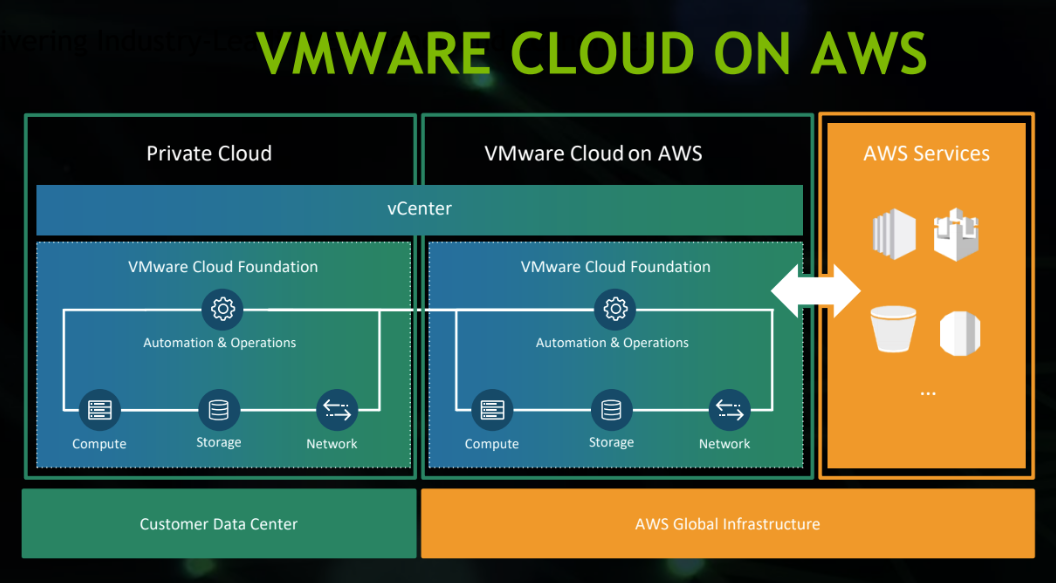
Nvidia today announced that it has been working with VMware to bring its virtual GPU technology (vGPU) to VMware’s vSphere and VMware Cloud on AWS. The company’s core vGPU technology isn’t new, but it now supports server virtualization to enable enterprises to run their hardware-accelerated AI and data science workloads in environments like VMware’s vSphere, using its new vComputeServer technology.

Traditionally (as far as that’s a thing in AI training), GPU-accelerated workloads tend to run on bare metal servers, which were typically managed separately from the rest of a company’s servers.

“With vComputeServer, IT admins can better streamline management of GPU accelerated
virtualized servers while retaining existing workflows and lowering overall operational costs,” Nvidia explains in today’s announcement. This also means that businesses will reap the cost benefits of GPU sharing and aggregation, thanks to the improved utilization this technology promises.

vComputeServer works with VMware Sphere, vCenter and vMotion, as well as VMware Cloud. Indeed, the two companies are using the same vComputeServer technology to also bring accelerated GPU services to VMware Cloud on AWS. This allows enterprises to take their containerized applications and from their own data center to the cloud as needed — and then hook into AWS’s other cloud-based technologies.
2019 08 25 1849

“From operational intelligence to artificial intelligence, businesses rely on GPU-accelerated computing to make fast, accurate predictions that directly impact their bottom line,” said Nvidia founder and CEO Jensen Huang. “Together with VMware, we’re designing the most advanced and highest performing GPU- accelerated hybrid cloud infrastructure to foster innovation across the enterprise.”


from TechCrunch https://ift.tt/2KUkjgW

Comments

Popular posts from this blog

Bill Gates steps down from Microsoft’s board to focus on philanthropy

In an announcement on Friday, Microsoft revealed that company co-founder Bill Gates has decided to step down from his role on its Board of Directors in order to focus on his philanthropic efforts at the Bill & Melinda Gates Foundation. This is Gate’s biggest change to his role at Microsoft since stepping down as company chairman in February 2014. According … Continue reading from SlashGear https://ift.tt/2We90Gu

World Economic Forum launches Global AI Council to address governance gaps

The World Economic Forum is creating a series of councils that create policy recommendations for use of things like AI, blockchain, and precision medicine. Read More from VentureBeat http://bit.ly/2EKBjD4

A Mini USB Keyboard That Isn’t A Keyboard

A useful add-on for any computer is a plug-in macro keyboard, a little peripheral that adds those extra useful buttons to automate tasks. [ Sayantan Pal] has made one, a handy board with nine programmable keys and a USB connector, but the surprise is that at its heart lies only the ubiquitous ATmega328 that you might find in an Arduino Uno. This isn’t a USB HID keyboard, instead it uses a USB-to-serial chip and appears to the host computer as a serial device. The keys themselves are simple momentary action switches, perhaps a deluxe version could use key switches from the likes of Cherry or similar. The clever part of this build comes on the host computer, which runs some Python code using the PyAutoGui library. This allows control of the keyboard and mouse, and provides an “in” for the script to link serial and input devices. Full configurability is assured through the Python code, and while that might preclude a non-technical user from gaining its full benefit it’s fair to say that ...